NRDZ Capstone
Experiments
Capstone experiments are the program’s culminating field deployments — long-duration, persistent RDZ operations at real-world sites that validate spectrum sharing at scale, from a passive radio astronomy observatory to an active spectrum research platform.
Hat Creek Radio Observatory
Capstone A is a long-duration (~3 month), persistent RDZ experiment at the Hat Creek Radio Observatory (HCRO) in Northern California — home of the Allen Telescope Array (ATA). It builds directly on the successful November 2025 exercise, scaling from a short field exercise to continuous, remote-operated monitoring and spectrum sharing experimentation.
The primary scenario is RA facility spectrum sharing: terrestrial systems, such as Smart Meters, long range (LoRA) devices, etc.,co-existing with the ATA radio telescope — with the RDZ framework providing protection, monitoring, and experiment control.
The ATA at HCRO observes across a wide frequency range with high sensitivity, making receiver protection a hard constraint. The 900 MHz ISM environment at HCRO includes both controlled transmissions and uncoordinated real-world Smart Meter signals, creating a realistic mixed-signal coexistence scenario.
Capstone A will also serve as the design basis for Capstone B, refining the toolkit and methodologies before moving to a more complex, multi-system environment.
Proof-of-Concept
Briefing ✓
(In Planning)
Experiment Begins
What Capstone A Must Demonstrate
The NSF Government Stakeholder Briefing (February 2026) defined six critical outcomes that Capstone A must achieve to validate the RDZ framework and inform Capstone B design.
Persistent, Continuous RDZ Monitoring
Demonstrate reliable, long-duration spectrum monitoring across the HCRO site — not just during scheduled exercise windows, but continuously over the ~3 month deployment period. Success is defined as uninterrupted sensor operation across all RFS sites for the full deployment period, with no gaps exceeding a defined threshold.
Experiment Control via ZMS
Confirm that the OpenZMS Zone Management System can reliably gate and control experiment transmissions, ensuring ATA protection is enforced throughout the deployment. This includes demonstrating both scheduled gating (ZMS-directed transmission windows) and real-time inhibit capability when ATA protection thresholds are exceeded.
DSP/ML Algorithm Validation
Validate the full suite of spectrum awareness algorithms under realistic long-duration conditions: correlation detectors, energy-based bounding-box detection, and AI/ML classifiers. Algorithms are evaluated in 900 MHz ISM, under real-world propagation and interference conditions at HCRO.
Multi-Sensor Data Management
Establish end-to-end data management for event-based, multi-sensor collections: structured ingestion, annotation workflows, and archival for the RF dataset working group. Data products include time-synchronized, multi-node spectrograms with event-level annotations, formatted for release to the RF dataset research community.
Remote / Off-Site Operations
Execute and observe the experiment entirely from an off-site, remote location using Starlink connectivity — validating the operational model for future RDZ deployments where travel is impractical. All experiment commanding, monitoring, and data access occurs remotely without on-site presence required during normal operations.
Capstone B Design Refinement
Use Capstone A lessons learned — toolkit gaps, operational procedures, data management workflows — to refine the design specification for Capstone B at a spectrum research facility. Lessons captured at Capstone A CDR will directly inform site selection, system configuration, and participant requirements for Capstone B.
Capstone A at HCRO
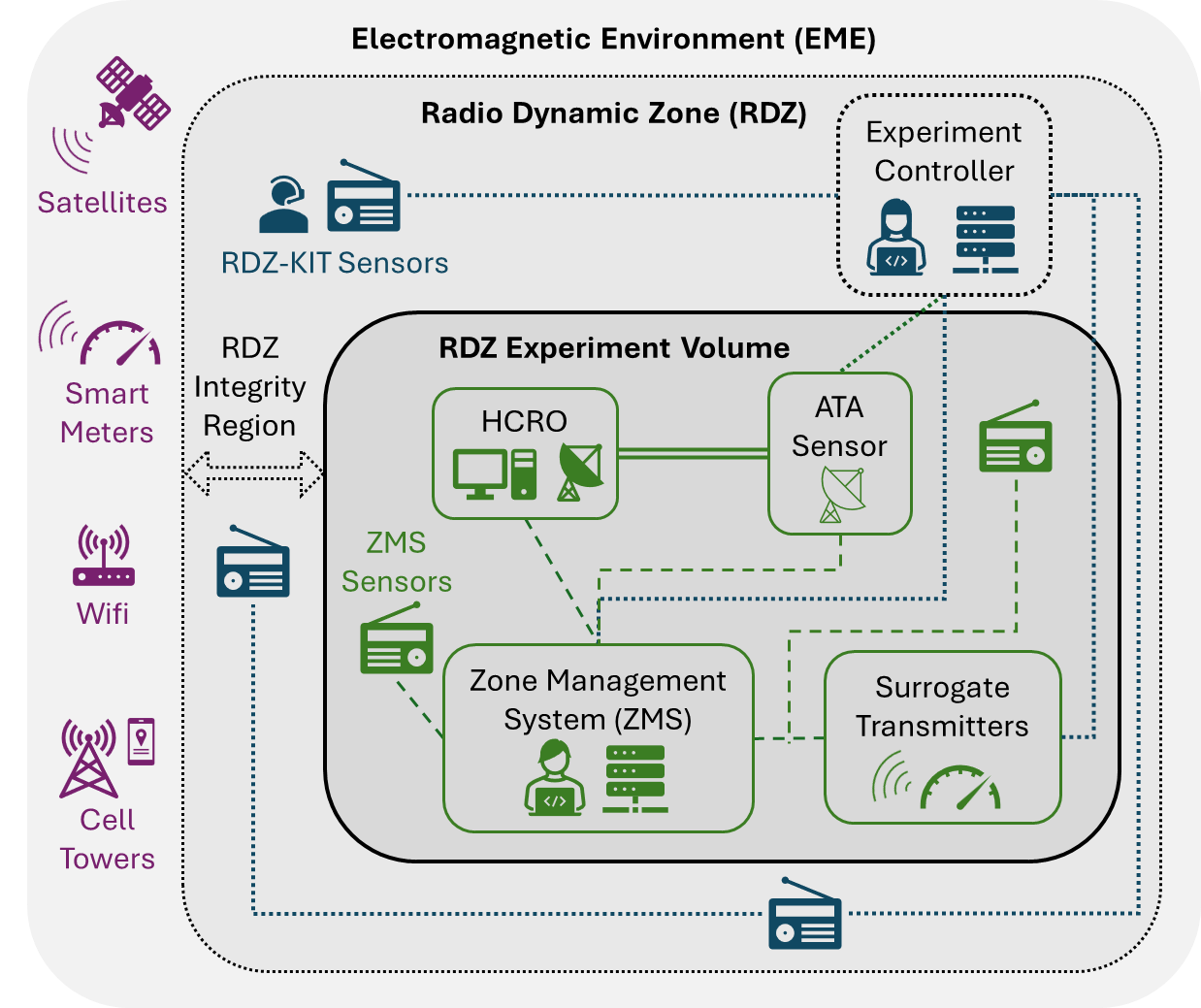


For more details, see our report:
Dynamic Spectrum Sharing Experiment Design and Setup at Hat Creek Radio Observatory.
Types of RDZ Activities
Capstone A operations are organized into four distinct activity types, each serving a specific role in the long-duration experiment execution.
RDZ Routine Operations
Continuous, steady-state activities conducted to keep the RDZ running in a stable, known configuration between special evolutions. Includes routine monitoring, housekeeping, baseline and continuity data collection, and maintaining operational awareness and system stability.
RDZ Readiness Checks
Periodic activities performed at regular intervals to confirm — and when needed, restore — that the HCRO RDZ is fully operational and ready to support planned and on-demand work. Includes calibration, verification, functional checkouts, health assessments, and corrective maintenance. Readiness-driven, not experiment-driven.
RDZ Scheduled Experiments
Pre-planned experimental procedures executed according to the Capstone timeline and defined cadence. These activities follow approved protocols — objectives, configurations, execution steps, and data products — and are coordinated in advance to ensure required resources, conditions, and readiness are in place.
RDZ On-Demand Activities
Unscheduled experimental activities executed in response to emerging needs, observations, or opportunities during the Capstone. May include follow-up runs to refine findings, exploratory trials, contingency experiments, or short-notice investigations. Question-driven (data and learning objectives), distinct from readiness work.
Spectrum Research Facility — Site TBD
Capstone B is the program’s second major long-duration experiment, targeting a spectrum research facility that offers a more complex, multi-system environment. It will leverage the toolkit, processes, and lessons developed during Capstone A — expanding the RDZ-KIT capabilities to handle richer, heterogeneous spectrum sharing scenarios.
Unlike Capstone A’s single-incumbent RA coexistence scenario, Capstone B will involve multiple active spectrum systems operating simultaneously, moving toward the realistic heterogeneous spectrum environments that the program ultimately targets.
Capstone B design will be formally initiated once Capstone A lessons learned are captured, with a target start of Fall 2027.
Begins
Final Delivery
Capstone B Site
Design Intent